
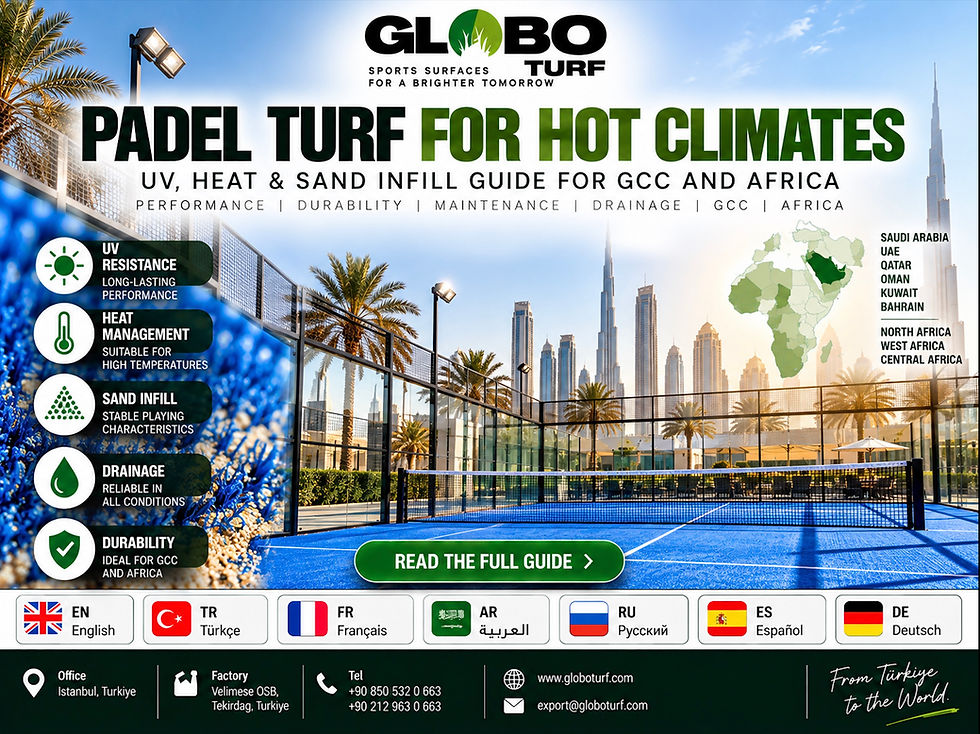
Padel Turf for Hot Climates: UV, Heat & Sand Infill Guide for GCC and Africa
Choosing the right padel turf for hot climates is essential for court performance, player comfort and long-term durability.
In Saudi Arabia, the UAE, Qatar, Oman and many African markets, outdoor padel courts face intense sunlight, high temperatures, airborne dust and, in coastal locations, salt-laden air.
For investors, sports clubs, contractors and distributors, choosing artificial grass based only on price or appearance can lead to unnecessary maintenance and premature replacement.
This guide explains the key technical factors to consider when selecting padel court turf for GCC and African projects.
Why Hot Climates Require Different Padel Turf Specifications
Padel courts in hot regions operate under demanding environmental conditions.
Important challenges include:
Prolonged UV exposure
High surface temperatures
Dust and sand accumulation
Seasonal heavy rainfall
Coastal humidity and salt exposure
Intensive daily court usage
These conditions affect the entire court system, including the artificial turf, backing, adhesives, drainage and supporting infrastructure.
A suitable specification should consider both the playing surface and the local environment.
UV Resistance and Fibre Durability
UV exposure is a critical factor in outdoor artificial turf performance.
Prolonged sunlight can contribute to colour fading, fibre degradation and changes in mechanical properties.
When selecting UV-resistant padel turf, buyers should request:
UV stabilisation information
Relevant accelerated-weathering test results
Fibre composition and construction
Colourfastness data
Warranty terms and environmental limitations
Polyethylene (PE) monofilament fibres are commonly used in modern padel turf systems.
However, not all PE products provide the same durability. Performance depends on fibre formulation, manufacturing quality and the complete turf construction.
A supplier should provide technical documentation rather than relying on general UV-resistant marketing claims.
Textured Monofilament vs Straight Padel Turf
Padel turf systems are available in different fibre configurations.
Textured Monofilament Padel Turf
Textured or curly monofilament fibres are commonly selected for professional-style padel courts.
Potential advantages include:
Stable playing characteristics when correctly installed
Support for appropriate sand distribution
Consistent surface appearance
Suitability for demanding playing schedules
Straight Monofilament Padel Turf
Straight monofilament systems are also used in padel installations.
Their performance depends on pile height, fibre density, sand infill and maintenance.
The best choice is not determined by fibre shape alone. The complete turf system should meet the intended playing requirements.
For tournament projects, buyers should verify applicable International Padel Federation (FIP) requirements and any event-specific approval conditions.
Pile Height, Stitch Density and Technical Specifications
Professional padel turf selection requires more than a product name.
A technical datasheet should identify:
Parameter | What Buyers Should Check |
Fibre material | PE or specified polymer |
Fibre type | Textured or straight monofilament |
Pile height | Commonly around 10–15 mm, depending on system |
Dtex | Declared fibre linear density |
Stitch density | Declared density and measurement units |
Backing | Construction and dimensional stability |
UV resistance | Test method and results |
Infill | Recommended silica sand specification |
Drainage | System compatibility and base requirements |
For many professional-style applications, textured monofilament systems in the 10–12 mm range may be considered, subject to the manufacturer's specification and applicable competition requirements.
No single pile height or stitch density guarantees performance. The entire installed system must be evaluated.
Sand Infill Selection and Surface Maintenance
Silica sand plays an important role in many padel turf systems.
Correct infill helps support the fibres and contributes to the intended playing characteristics.
For GCC and African projects, buyers should evaluate:
Sand particle size distribution
Particle shape and cleanliness
Compatibility with the selected turf
Manufacturer-recommended application quantity
Uniformity of installation
Maintenance and redistribution requirements
Excessive or uneven sand can affect ball behaviour and player movement.
Insufficient infill may also compromise the intended performance of the surface.
In desert environments, windblown dust and sand should not be confused with the specified sports-surface infill.
Regular inspection and appropriate cleaning are essential.
Surface Heat and Player Comfort
Artificial turf exposed to direct sunlight can become significantly hotter than the surrounding air.
Surface temperature depends on several factors, including fibre characteristics, colour, solar radiation, ventilation and the complete surface construction.
Buyers should avoid assuming that a particular turf colour or fibre type automatically guarantees a cooler playing surface.
For outdoor padel facilities in Saudi Arabia, the UAE and other hot regions, consider:
Court orientation and shading opportunities
Suitable playing schedules
Surface-temperature monitoring
Player rest and hydration facilities
Heat-management measures supported by the manufacturer
Player comfort and heat safety should be assessed as part of the overall facility design.
Padel Turf Drainage in Hot and Coastal Regions
Hot climates do not necessarily mean low rainfall.
Some GCC and African locations experience intense seasonal rainstorms.
A properly engineered padel court should account for:
Local rainfall intensity
Sub-base stability
Surface level tolerances
Appropriate drainage arrangements
Water evacuation beyond the court
Coastal projects also require attention to corrosion protection for surrounding metal structures and the durability of installation materials.
Good drainage design helps protect both the playing surface and the wider court investment.
Indoor vs Outdoor Padel Turf
Indoor and outdoor courts have different environmental demands.
Outdoor padel turf requires particular attention to UV exposure, weathering, drainage and temperature.
Indoor installations may experience reduced direct UV exposure but still require suitable ventilation, cleaning and humidity management.
In either environment, turf selection should reflect expected playing intensity and the intended competition level.
Padel Turf Selection for GCC and Africa
Regional conditions should guide the specification.
Saudi Arabia, UAE, Qatar and Oman: Prioritise UV performance, surface heat management, airborne dust and outdoor maintenance.
North Africa: Consider solar exposure, seasonal temperature variation and coastal conditions where relevant.
West and Central Africa: Evaluate rainfall, humidity, drainage, installation conditions and maintenance resources.
Rather than applying one identical specification everywhere, buyers should request a project-specific technical proposal.
Technical Checklist Before Ordering Padel Turf
Before confirming a purchase, request:
Complete technical datasheet
UV and durability test documentation
Recommended sand infill specification
Installation and drainage requirements
Cleaning and maintenance instructions
Warranty conditions
Applicable FIP compliance or approval documentation, where required
Packing, delivery and export information
This checklist helps buyers compare offers on technical value rather than price alone.
Request a Padel Turf Quotation from Globo Turf
Globo Turf supports international sports surface and padel court projects, with a focus on technical product selection, export supply and sports infrastructure solutions.
For projects in the GCC and Africa, our team can review the intended application, climate conditions and project requirements to help identify an appropriate padel turf specification.
Planning Padel Courts in Saudi Arabia, UAE or Africa?
Contact Globo Turf for technical consultation and a project-specific quotation.
GLOBO TURF | Sports Surfaces & Infrastructure
Office: Istanbul, Turkiye
Factory: Velimese OSB, Tekirdag, Turkiye
Tel: +90 850 532 0 663 & +90 212 963 0 663
WhatsApp: +90 532 469 61 35
Email: export@globoturf.com
Website: https://www.globoturf.com
From Türkiye to the World.


Comments